
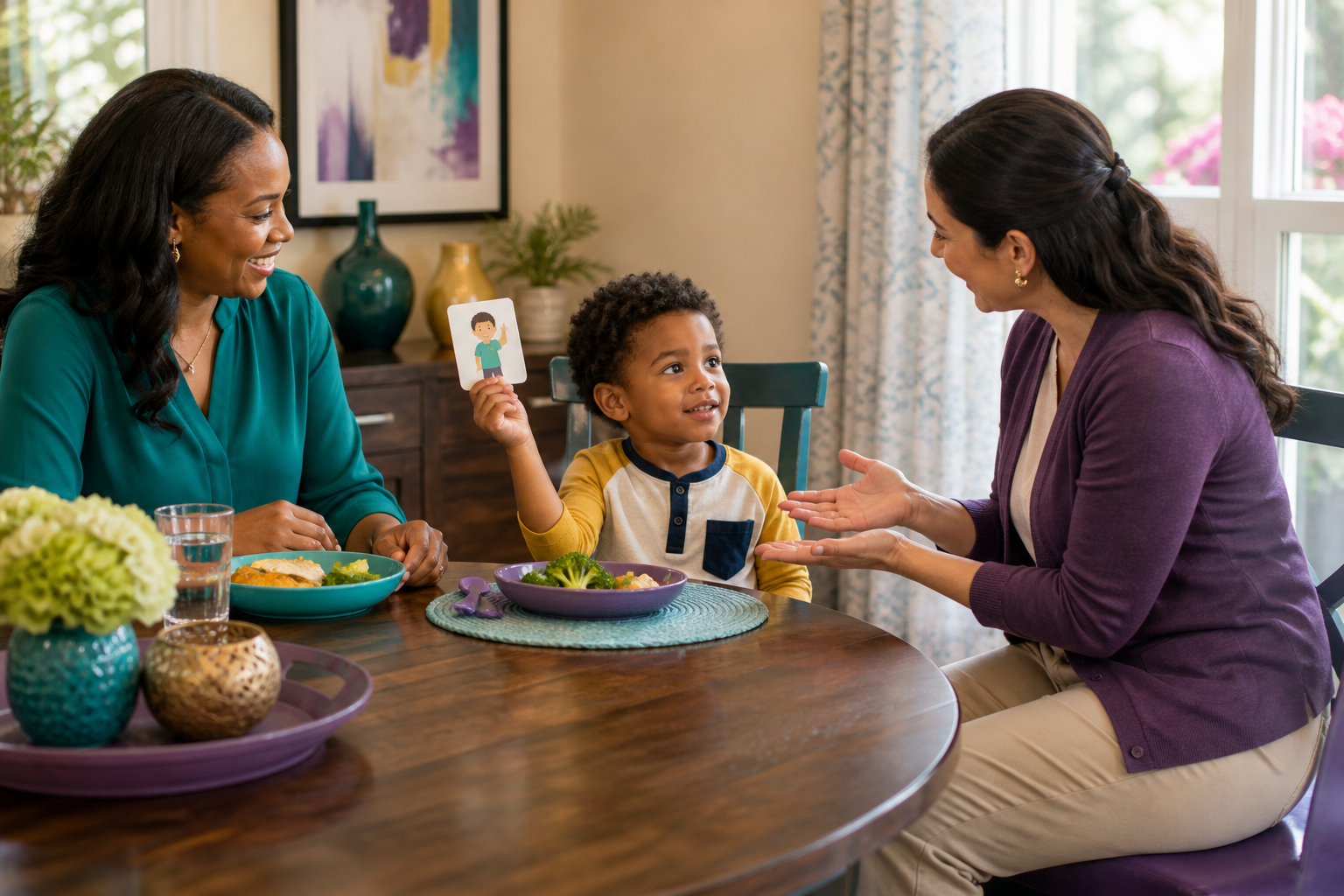
ABA parent coaching gives Georgia families practical strategies for the routines that are hardest at home, and for many families that means dinner and bedtime. When every adult in the house responds to the same behavior in the same way, a child learns the routine faster.
Those two times of day are hard for a reason. Everyone is tired, the schedule is tight, and there is not much room for things to go sideways. Coaching gives you a plan for those moments, built with your child’s Board Certified Behavior Analyst (BCBA) and practiced with support.
What does caregiver coaching look like in in-home ABA?
Coaching happens in real time, in your home. At Samba ABA, parent and caregiver training is part of every plan, and it usually follows a simple rhythm.
First, the BCBA or the Registered Behavior Technician (RBT) shows you a strategy with your child. Then you try it while they watch. Next, they give you specific feedback: what worked, what to change, and what to try in the future.
That live coaching is supported by separate training time, written and visual resources you can keep on the fridge, and regular check-ins with your BCBA.
The check-ins matter more than parents expect. If you tell the BCBA that bedtime fell apart three nights in a row, that information changes the plan. Maybe the routine has too many steps. Maybe the timing is off. Your reports from the hours between sessions are data, too.
Why does consistency help skills carry over at home?
Behavior analysts use the word generalization for a skill that shows up with different people, at different times, and in different places. It is the difference between a child who asks for “more” only with their RBT and a child who asks for “more” with everyone.
Consistency is how you get there. If the RBT waits for your child to sign “all done” before clearing the plate, but at dinner the plate disappears the moment your child pushes it away, your child is learning two different rules. When parents, grandparents, and the RBT all wait for “all done,” the rule becomes clear.
That is the whole point of coaching. It makes the routine the same no matter who is running it.
How can your BCBA help build calmer mealtime routines?
Mealtime goals look different for every child. Your BCBA will set them with you based on what is happening at your table. Common strategies include:
- A visual mealtime sequence. Pictures showing wash hands, sit down, eat, say “all done,” and put the plate in the sink make the routine predictable.
- A predictable seat and start cue. The same chair and the same signal (“time to eat”) every meal.
- Short sitting goals that grow. If your child currently sits for two minutes, the first goal might be three. Small increases are easier to reach and reinforce.
- Teaching “more” and “all done.” Giving your child a clear way to ask for food or end the meal can reduce the behaviors they use instead.
- Low-pressure exposure to new foods. When it is part of the plan, a new food might start as something that sits on the table or the edge of the plate, with no expectation to eat it.
- Reinforcement for target behaviors. Praise, a preferred activity after the meal, or whatever your BCBA identifies as motivating for your child.
Coaching does not replace medical care. If you have concerns about weight, nutrition, chewing, or swallowing, talk with your pediatrician. The ATN/AIR-P guide to exploring feeding behavior in autism is a helpful starting point for understanding mealtime challenges.
How can you bring structure to bedtime routines?
Bedtime goes better when it looks the same every night. Strategies your BCBA may coach you on include:
- A visual bedtime schedule. Bath, pajamas, teeth, story, lights out, in pictures your child can follow. The ATN/AIR-P visual supports tool kit shows how to make and use them.
- First-then language. “First pajamas, then story.” It tells your child what is happening now and what comes next.
- The same order every night. Changing the order, even slightly, can turn a familiar routine into a new one.
- A wind-down period. Screens off and lights lower before the routine starts.
- Reinforcement for following the routine. This might be a favorite song at lights out or a special breakfast choice in the morning.
Here is where coaching makes the biggest difference. If one parent does bedtime one way and the other parent does it differently, the visual schedule will not help much. Coaching gets everyone who handles bedtime using the same steps, the same words, and the same response when your child gets out of bed.
If sleep problems continue, check in with your pediatrician. The ATN/AIR-P sleep strategies guide offers more ideas for families.
How do you partner with your BCBA on routine goals?
You know your child better than anyone on the team, and your observations shape the plan. Before a check-in, it helps to note:
- What happens right before and right after hard moments
- What you have already tried, and what happened
- Which routine matters most to your family right now
Expect goals to change. When your child masters one step, the BCBA will add the next. When something is not working, the plan gets adjusted. For more on how this partnership works, read the importance of parent training in ABA therapy.
Frequently asked questions
Do I have to be present for every session?
A parent or caregiver is usually home during sessions, especially for younger children. Being there is also when much of the coaching happens.
Can grandparents or other caregivers join the training?
Yes. Grandparents and other primary caregivers can take part, which helps keep routines consistent across everyone who cares for your child.
Is caregiver coaching an extra cost?
Caregiver training is included in every Samba ABA plan.
Want help with the hardest parts of your day?
Small changes, used the same way by everyone at home, can make mealtime and bedtime more predictable for your whole family. If those routines are a struggle right now, we can talk about what in-home ABA and caregiver coaching might look like for your child.
Schedule an intake call with Samba ABA or call (404) 779-8860.