
In-home ABA therapy services in Atlanta from Samba ABA bring the full scope of Applied Behavior Analysis (ABA) care into your home: assessment, an individualized treatment plan, one-on-one sessions, and coaching for the adults in your child’s life. We work with children and teens ages 2 through 21 who have an autism diagnosis, in Midtown and communities across Fulton County.
What do in-home ABA therapy services in Atlanta include?
“Comprehensive” can sound like marketing, so here is what it means in practice. Samba ABA’s in-home ABA therapy in Atlanta covers every stage of care, and all of it happens at home.
It starts with an in-home behavioral assessment. A BCBA observes your child in their own space, talks with you about daily life, and uses standardized tools to understand current skills. This is not a diagnostic evaluation. Its job is to decide what to teach first.
From there, the BCBA writes a treatment plan with measurable goals. Depending on your child, those goals might cover:
- Communication and social skills, such as asking for help or joining a game
- Self-care and daily living, such as dressing, toileting, or handwashing
- Attention and executive functioning, such as waiting or switching between activities
- Motor skills
- Behaviors that show up mainly at home, like bedtime resistance or difficulty with transitions
An RBT then delivers regular one-on-one sessions, with the BCBA supervising throughout. Caregiver training runs alongside sessions from the beginning, so the strategies your child is learning carry into the rest of the day.
How does your child build skills at home and around the neighborhood?
Atlanta families live in every kind of space, from Midtown high-rises to houses with a backyard. In-home ABA works with whatever space you have, because the goal is to teach skills inside the routines your child actually lives.
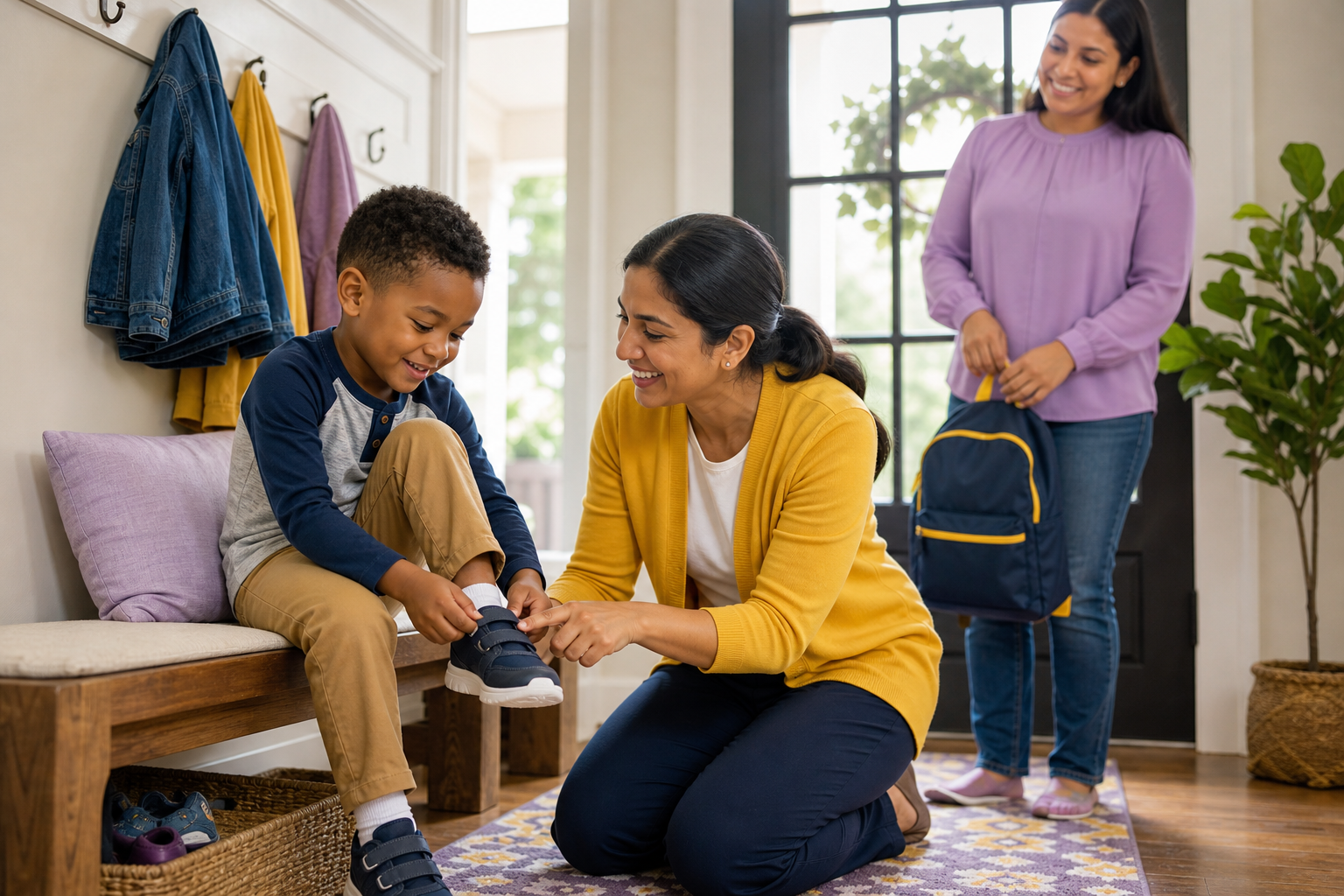
That might mean practicing putting on shoes during the real rush to get out the door. It might mean taking turns with a sibling in the living room, or asking for “more” at dinner.
When the BCBA includes it in the plan, skills can also be practiced close to home. A child who struggles with waiting might rehearse it before a walk to the neighborhood park or a trip to the grocery store, so the real outing goes more smoothly.
The reason is simple. A skill learned in the place where it is needed does not have to be relearned somewhere else. Behavioral approaches like ABA have the strongest evidence base for treating autism symptoms, according to the CDC, and teaching in real settings is one way to help that progress hold up day to day.
How do the BCBA and RBT work together on your child’s plan?
Think of the BCBA as the clinical lead and the RBT as the person who carries the plan out session by session.
The BCBA designs the plan, then stays involved. They review the data the RBT collects, observe sessions in your home, coach the RBT on technique, and adjust goals when your child masters a skill or needs a different approach.
A Registered Behavior Technician holds a paraprofessional certification from the Behavior Analyst Certification Board and works under a BCBA’s supervision. Your child will spend most of their therapy time with their RBT, so that relationship gets a lot of attention early on.
Samba ABA’s clinical team is led by founder Dr. Kristine Cortez, Ed.D., BCBA, LBA.
Is in-home or clinic-based ABA better for Atlanta families?
In-home ABA tends to suit families who want therapy built into daily routines and who would rather not add a cross-town drive to an already full schedule. Some children do well in a clinic, with other children around and a setting that is separate from home.
Whichever you are considering, ask these questions:
- Where will sessions happen, and who decides?
- How often will a BCBA be present or observing?
- How does caregiver training work, and is it included?
- How soon is the first formal progress review?
Our guide to the difference between in-home and clinic-based ABA therapy goes deeper.
How does insurance work, and how do you get started in Fulton County?
Georgia Medicaid covers ABA for children under 21 with an autism diagnosis through the Early and Periodic Screening, Diagnostic, and Treatment (EPSDT) benefit. Samba ABA accepts Wellpoint and CareSource, and Medicaid-enrolled children usually pay nothing for covered services. For private insurance, we work with Blue Cross Blue Shield, Anthem, and Alliant. These plans generally require prior authorization. For more on Medicaid, read Does Georgia Medicaid Cover ABA Therapy for Children with Autism?
Getting started looks like this:
- An intake call, where we verify your insurance and explain the documents you need (usually the diagnosis report and a physician referral)
- An in-home BCBA assessment
- A written treatment plan with measurable goals
- Regular sessions with an RBT, plus caregiver training
If you are still gathering local support, our list of autism resources in the Atlanta metro and Coweta County is a useful place to look.
Frequently asked questions
What ages does Samba ABA serve in Atlanta?
Children and teens ages 2 through 21 with a formal autism spectrum disorder diagnosis.
Does in-home ABA therapy work in an apartment or a small home?
Yes. Sessions use the space you already have. A corner of the living room and the kitchen table are often all an RBT needs.
How soon will we see a progress review?
The first formal BCBA progress review happens between weeks eight and twelve. The BCBA watches data and adjusts goals during this time as needed.
Does Samba ABA provide autism diagnoses?
No. A diagnosis from a qualified provider is needed before therapy starts.
Ready for in-home ABA therapy in Atlanta?
Care that comes to your Atlanta home means your child learns where they live, and you learn right alongside them. The next step is a conversation about your child and your coverage.
Schedule an intake call with Samba ABA or call (404) 779-8860.